Westeros
The 'A Song of Ice and Fire' Domain
Features
Having had a chance to watch Game of Thrones: The Mad King last month, afterwards I went out and visited with the actors as they left at the stage door at the Royal Shakespeare Theatre. One of the actors I met and had a wonderful conversation with was Michael Shaeffer, who played the titular Mad King, Aerys II.
He very kindly agreed to sit for an interview to discuss the play, his thoughts on Aerys, and more, The interview was conducted a couple of weeks ago, well before the official announcement that the play would be moving to London in 2027. It has been edited and condensed for length and clarity.
Elio Garcia: This was the first play I had ever attended. I have read Shakespeare, but reading Shakespeare is not really how you are supposed to experience it, and I had not realized how magical and immersive live performance could be. How does acting onstage differ from acting for the screen? What is different about the energy?
Michael Shaeffer: Very, very different. In the theatre, everything is different every night, and there is a physicality that you have to bring to it. Especially with The Mad King, it is a kind of muscular thing: nearly four hours of quite full-on effort. Everything matters in this world. There are very few casual, “Hey, how are you doing?” moments. It is life-and-death stuff all the time, and that has a demand to it. It requires you to pull yourself up to it.
You really have to get ready for it; you cannot just wander on. We all turn up two hours before the show begins to start warming up, and it takes that time to reach the level we need to deliver it in the way it needs to be delivered—and to deliver it safely. We go through the safety work every night.
Then there is the audience. Audiences react differently every night; some are more vocally responsive than others. But with this show, every night the audience has been with us. You know when an audience is not with you: you can feel and hear it, and people begin to shuffle and become uncomfortable. In spite of this being a fairly lengthy show, people stay with us. You can hear a pin drop all the way through to the end. People are right there with us, which is wonderful.
That connection with the audience is the thing you do not get in front of a camera. When you are filming, you do your thing and never quite know: was that all right? You have to trust that the director will tell you if they want something different. In a theatre, you feel it. The audience tells you. There is a constant feedback loop, and when you have done a lot of theatre your antennae become attuned to whether it is working. It is a magical thing. I love it. I really do.

First, a disclosure: it has been a very long time since I seriously played this particular kind of real-time strategy game. The last one I spent much time with was Warcraft: Orcs & Humans, back in 1995. I never moved on to StarCraft, Total Annihilation, Command & Conquer and the rest. Some Total War, yes, but that’s a different beast in a lot of ways. So, with that out of the way, and the recognition that it means I’m not really in a position to tell experienced RTS players whether Game of Thrones: War for Westeros is doing something revolutionary or even exceptional for the genre. But I can give my near-neophyte impressions, and also share how well the game captures the feel of Game of Thrones (and ASoIaF) in its tactical gameplay.
The verdict? Quite impressed!

The theater grew dark, save for a flame in the middle of set designer Chloe Lamford’s cross-shaped stage. Two servants of House Whent, dressed in the yellow and black livery, marched out purposefully from the doors beneath where I sat in the Circle, down the long, long way to the great tall doors that represented the gates of Harrenhal. There was an ominous sound beyond, of many feet and hoofs, coming nearer, nearer. The doors were thrust open, and an intense light from lighting designer Jon Clark flooded through, limning the figures that followed: men and women bearing the strange three-headed red dragon on black, a tall man with silver hair on a great horse, a smaller man behind him, each dismounting before passing out of sight. On and on the procession went, a litter bearing a pregnant princess carried by attendants, her own attendants following her. Above, crows (or ravens?) flew, cawing, wings flapping. A dog sniffed the heels of the horses, chased away some commoner.
So began Game of Thrones: The Mad King, the immersive, epic play based on George R.R. Martin’s deep history for A Song of Ice and Fire, adapted by Duncan Macmillan and directed by Dominic Cooke. This long procession featured many of the elements of what the play would unveil over its 3 hour, 40 minute run time (including a 20 minute interval): the wondrous puppetry and movement of Nick Barnes and Finn Caldwell of Lume, costume designer Georgia McGuinness’s bold pop-modernist color blocking in the heraldry, the drama of composer Will Stuart’s music and Tom Gibbons’s sound design and that enormous space where the audience surrounded the stage. But would the actual narrative of the play match that beginning?

Mariah Gale as Lady Shella Whent and the company in George R. R. Martin’s Game of Thrones: The Mad King.
With the first preview of Game of Thrones: The Mad King now having taken place (and to a standing ovation, too!), there has understandably been a great deal of discussion about its revelations and, especially, about which parts of the play are or should be considered “canon”.
Naturally, people have asked us about this because of our long involvement with George and his work, both as long-time fans and lore “experts”, and as collaborators on The World of Ice and Fire, so it may be useful to explain how we understand the situation, based on our experiences and knowledge. Before we start, though, a disclaimer: we have not directly spoken to George or the creatives about any of the specifics of the play. And, for that matter, we will do so without discussing the substance of the play or spoiling any of its details.
So, what is canon? That’s actually pretty simple.

[Editor’s note: Quotations have been lightly edited for concision and clarity.]
Tyler Jacobson, one of the leading illustrators in contemporary fantasy art and illustration, is best known for his work on Magic: The Gathering and Dungeons & Dragons—including standard covers for major Dungeons & Dragons core books, and a particularly famous piece for Magic: The Gathering that was a D & D crossover featuring Drizzt Do’Urden that sold at auction for $155,000, one of the highest M: TG original art sales on record —he brings more than a decade of experience in both traditional and digital illustration to the project, winning plaudits including recognition such as the prestigious Spectrum and Jack Gaughan awards.
He is now the latest notable artist to get involved in the long-running A Song of Ice and Fire calendar series, joining the likes of Ted Nasmith, Magali Villenueve, Gary Gianni, John Picacio, Sam Hogg, Arantza Sestayo, and many more. I had the pleasure of interviewing him just before he was set to travel to Amsterdam, the host of this year’s MagicCon, to discuss the 2027 A Song of Ice and Fire Calendar which is set to be released on July 21st (you can pre-order here. Not only do we discuss five of the pieces, including an exclusive piece never seen before, but he reveals just a bit about a couple of other of the pieces fans can look forward to.

Daenerys Targaryen with Drogon, Rhaegal, and Viserion. Art by Tyler Jacobson.
A Knight of the Seven Kingdoms, the new show from HBO set 90 years prior to the events of A Game of Thrones, takes that setting’s focus on the high lords and ladies of Westeros and turns it on its head. It brings viewers into a narrow focus on the life of a lowly hedge knight, Dunk – or Ser Duncan the Tall – and his young bald squire, Egg. Adapted from George R.R. Martin’s World Fantasy Award-nominated 1998 novella “The Hedge Knight”, the much-loved story and its characters are brought to life with real warmth, while adding some new elements that at times work very well and at other times… well, mileage may vary.

Peter Claffey as Dunk and Dexter Sol Ansell as Egg.
An interview long in the making, we finally got to sit down with Ryan Condal, lead writer, executive producer, and now sole show runner of House of the Dragon last week to talk about the show. After Linda had a chance to say hello, she headed off to keep an eye on our very rambunctious puppy Lancelot, we started the interview. We open up with a question on post-production, and then get into the weeds on favorite book characters, depictions of violence, heraldry, a forgotten Valyrian house, the change from book canon when casting the Velaryons, whether Ryan will continue with the show after completing this particular story, and more.

Ryan Condal behind the scenes with a maquette of Caraxes. ©️ Ollie Upton/HBO
A lot of words have been spent on discussing the tournament in the first episode of House of the Dragon, especially in regards to its incredible levels of violence and how that seems to be received by the audience of spectators in the show. A new video about the tournament scene—focused on the work needed to bring it to the screen—reminded us that we had some thoughts we wanted to share, expanding on some things we said in our “Not a Review”.
The release of the DracARys augemented reality app was a fun approach by HBO to market House of the Dragon, letting anyone with a mobile phone have their own pet dragon. While we were never stirred by Pókemon-mania, we’d each had Tamagotchi when we were young and playing with the app definitely inspired some nostalgia. So much so, that we check in with our dragons several times each day, and rush outside whenever there’s a notice of something interesting (such as the first visit by a dragon from Westeros).
Given our interest, and seeing that there’s a small but active community for the app, we reached out to HBO to see if we could talk to the creatives and developers behind the app. HBO led us to Victor Piñeiro and Samantha Garrison from HBO Max, as well as Kevin Young at The Mill, who kindly answered our many questions.
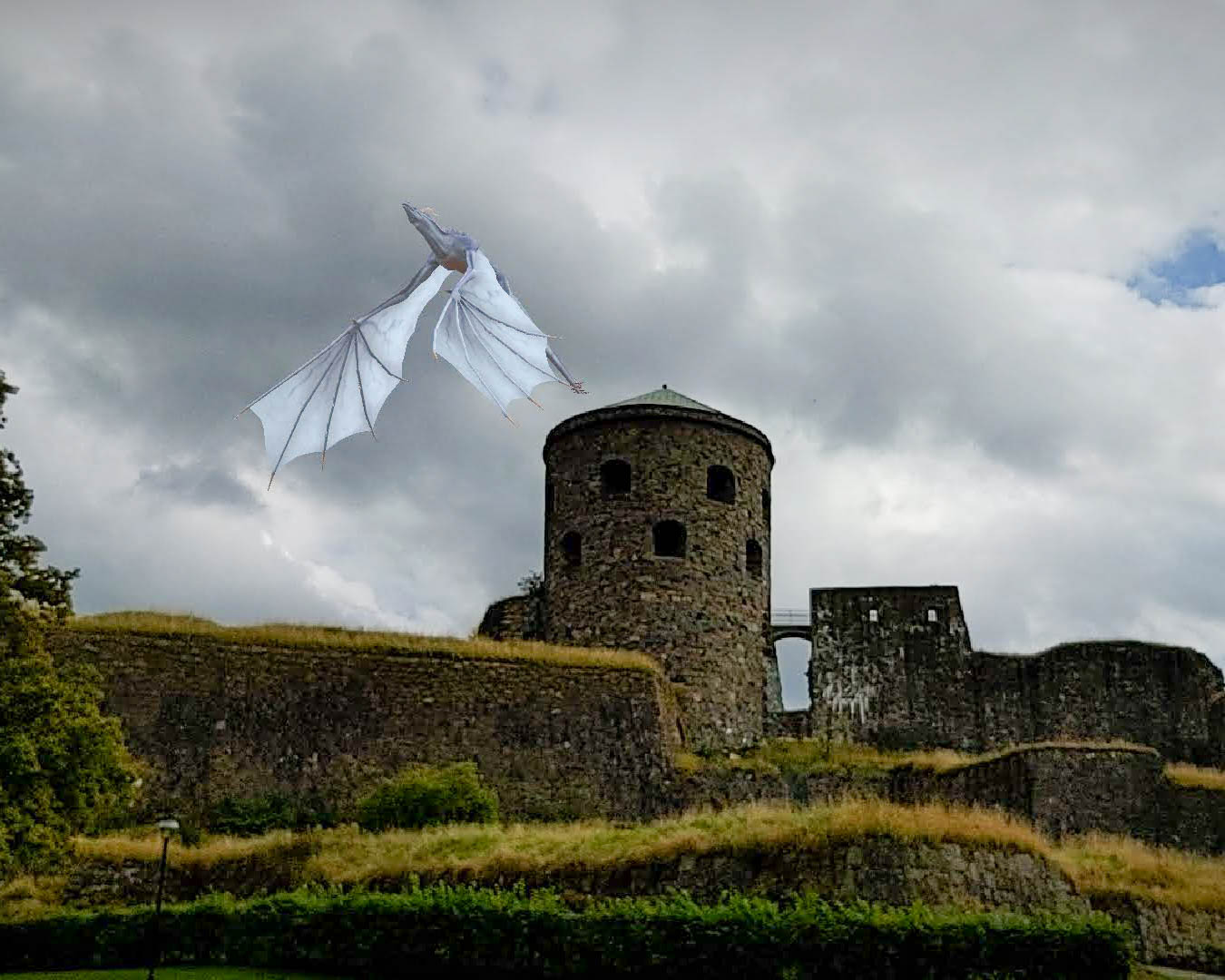
A dragon soars over Bohus Fortress
We’ve had the opportunity to watch the first six episodes of House of the Dragon, and we certainly have some thoughts about the show. Maybe too many thoughts.
Why This Isn’t a Review
First, a disclaimer: Linda and I have discussed a fair bit about how exactly to write about the show. The fact is that we have a connection to the Dance of the Dragon material that is unique. George first wrote the material, almost precisely as it is presented in Fire and Blood, for The World of Ice and Fire. A book we co-authored with him. And when it proved, as with most of the Targaryen material, well beyond the size we could publish in that book, we used it to summarize very, very concisely the events of the Dance, giving readers some of their first looks into that period. And now we’ve done it again, at George’s and Random House’s kind request, in the forthcoming The Rise of the Dragon (out on October 25th!)

I’ve had the pleasure of visiting a similar exhibit once before, four years ago in Stockholm, but that was at an entirely smaller scale than the touring exhibition as it now exists. An incredible range of costumes, armor, and other items like larger props were on display. The weapons and armor in particular always strike me as particularly interesting, so I’ve focused on those in this collection of images. Here, you see a close-up detail of Heartsbane, the Valyrian steel sword of House Tarly.
My understanding is that the stained glass features will remain up and available for tourists to visit for years to come, rather than being temporary installations. The Game of Thrones exhibition has closed its Belfast leg, however, and will re-open in Madrid (less the dragon skulls!) in October. However, a much more permanent and apparently elaborate exhibition will present itself next year, as we noted in April with the announcement that Linen Mill Studio will host a Game of Thrones studio tour beginning in Spring 2020. Should be an exciting destination for fans of the show, and we hope to have more details about it in the coming months.
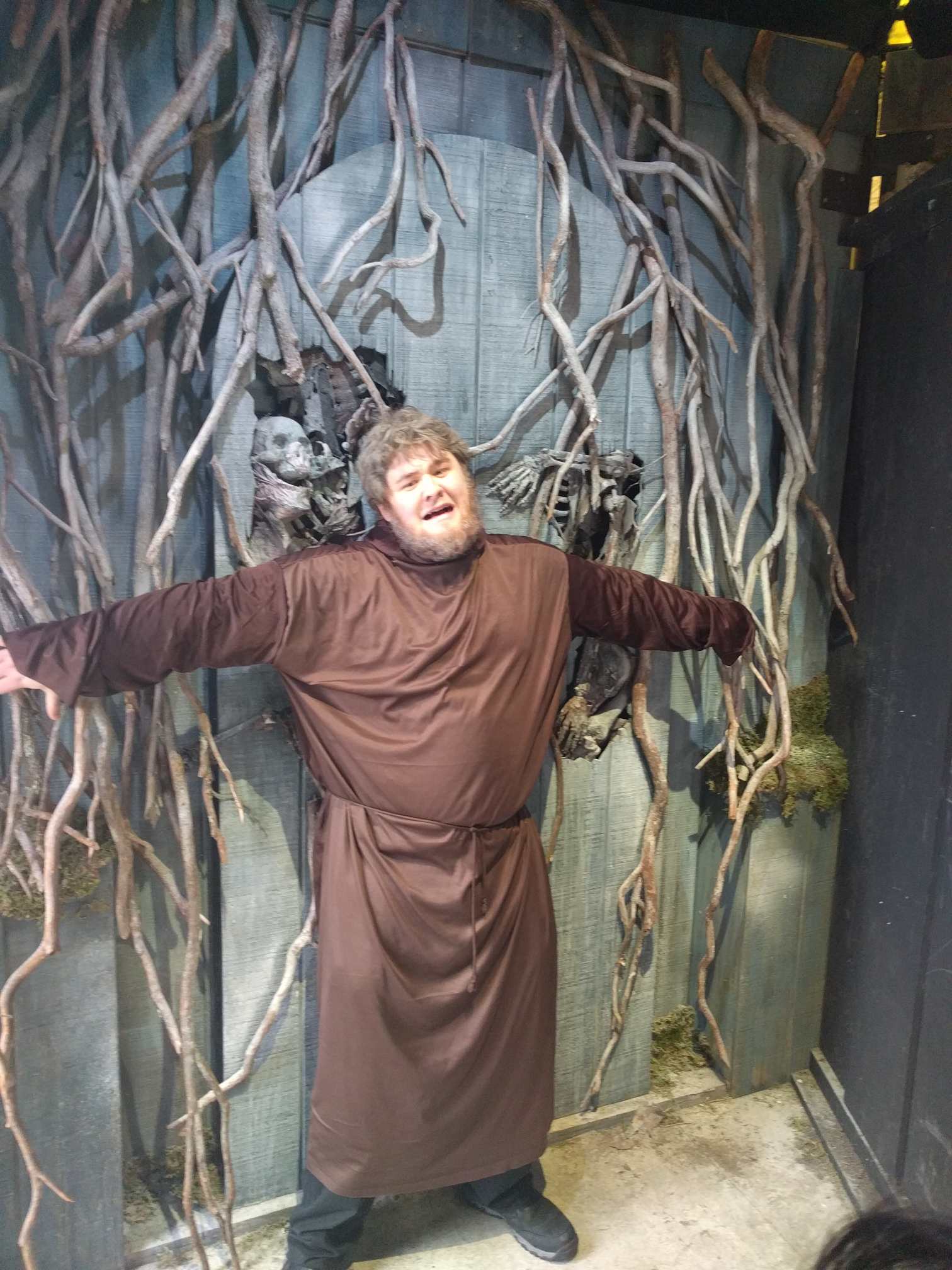
We’ve a special feature today courtesy of a fan, Christine, who attended the Game of Thrones exhibit in Chicago the weekend before last (there’s one more coming to Los Angeles on December 9th and 10th), with a look at all the neat stuff HBO has put together in celebration of the release of the Season 6 Blu-Ray... as well as an exclusive new interview with Finn Jones, who portrayed the late, great Knight of Flowers… and is now due to star in the Netflix Marvel series, Iron Fist. Read on to learn what Christine saw, and what Finn had to say about Game of Thrones and what he’s been up to since filming wrapped on the previous season!
To celebrate Game of Throne‘s sixth season and the November Blu-Ray release, HBO created a pop-up theme park, showcasing an interactive world of the special featured content, allowing die-hard fans to traverse Westeros as a Khaleesi, stave off a horde of wights north of the Wall, train as a soldier in the Night’s Watch, claim the Iron Throne, or get caught in a wave of deadly chaos in the Battle of Bastards. Plus, as a special treat to early arrivers, Finn Jones â`“ also known to fans as Sir Loras Tyrell â`“ was on site to meet and greet, sign copies, and spare a few minutes of his hectic schedule to talk music, politics, and of course the burning question â`“ how will Game of Thrones end?
These events, held in New York, Chicago, and this upcoming weekend in Los Angeles, recreate some of the most iconic sequences of season six and offer hands-on sneak peeks of the Blu-Ray bonus content. Set up by location, fans navigate throughout Westeros and Essos faster than if they were on dragonback. Each location replicates the set design on the show, with a treasure trove of memorabilia and fun inside.
On the final day of our visit to Northern Ireland we were taken to Glenarm (on the beautiful County Antrim coast, which we will be doing a video on soon) to see the store & workshop of Steensons who have produced some of the iconic pieces of jewellery seen on Game of Thrones such as Joffrey’s and Margaery’s wedding crowns and the lion pendants worn by Cersei, Myrcella and Sansa. Most recently, they made the crown donned by Cersei as she takes the throne in the final episode of season six. Some of these pieces are on display in their store, which allows for a very close look at them. As the store is also their workshop—and a so called économusée, where you can see craftsmen at work—you are also able to view their goldsmiths at work. Also available in the store—and in their store in Belfast—is their newly launched Game of Thrones collection, with necklaces, pins and cufflinks using elements of the designs they produced for the show. In our video below you will get a closer look at this collection as well as some of the unique pieces made for the show.
The Game of Thrones collection is as of yet not available on-line, but if you contact them via their website or via facebook, they can send you a catalogue showing the pieces and arrange for an order that way. Or you could take it as (yet another) reason to visit Northern Ireland!
The final stops on the tour of the Doors of Northern Ireland, alas!
Ballygally Castle is a terrific place, situated on the beautiful Antrim coast and featuring one of the oldest still-used buildings in Northern Ireland. Its garden was a real pleasure, and made us wonder a bit about how palm trees could grow in Northern Ireland (answer appears to be that prevailing ocean currents make Northern Ireland somewhat more temperate than the equally-northern reaches of the Nordic countries). We were warmly greeted and found that there was a large wedding reception going on, but that didn’t phase anyone as we were smoothly led to the dining room (it may have helped that our waitress recognized us from Thronecast!) We were treated to their menu for the Game of Thrones banquet they do, though with a variation: their Westeros-inspired tomahawk steaks were served as the main. Never had that cut before, and certainly never with that amazing presentation of a long, long rib bone jutting out. Absolutely delicious!
Belfast saw the unveiling of the final door at the Dark Horse pub, and this was quite the party with over a 150 people packed into the bar and spilling into the courtyard outside where fans could meet Odin and Thor, two of the dogs that were the direwolf puppies at the start of season 1 (they were Grey Wind and Summer, specifically). Their owners happen to have been extras on the show as well, and run Direwolf Tours in association with the Winterfell Tours based out of Castle Ward and its demense. Really handsome dogs, I have to say.
That’s more-or-less the end of our adventures in Northern Ireland, but as you’ll see in the video embedded above, we have a couple more videos planned thanks to our visit. One will be a video about the gorgeous Antrim coast (we’re both quite fond of beautiful coastlines!) but using that to springboard into a discussion of the coasts of Westeros (yep, ASoIaF geekery is coming), and one will be about our visit to Steensons jeweller’s store/workshop in Glenarm where we met Brona Steenson and her husband Dan Spencer who not only make beautiful jewelry, but specifically have made a number of the jewelry props for Game of Thrones (including Cersei’s latest crown!)
The road goes ever on and on, as the song goes, and our road took us to the lovely estate of Gracehill House and then the quaint, seaside Mary McBride’s bar to visit the 7th and 8th doors!
Gracehill House has a long history stretching back to the 17th century, when King James I of England (also James VI of Scotland) made a grant of land to a kinsman of his, a James Stuart. The man had the misfortune of drowning while journeying to take posession of the land, but his grandson inherited it and in time his descendants began building the house in the late 18th century. The famous Dark Hedges were in fact originally a part of the estate, the beech trees planted along the drive to make a suitably impressive path to the home. In more recent times, Gracehill House has changed hands and has been developed with an eye to becoming a premiere golf resort in Northern Ireland. It’s definitely a beautiful stately home, currently in the process of renovation to establish a number of well-appointed rooms for guests.
Mary McBride’s Bar is a very different experience as one goes to the eastern coast of Antrim. It’s a small town, and Mary McBride’s is (as so many of the pubs in Northern Ireland seem to be!) an institution in it, a place where the locals gather and share the news of the day. For Game of Thrones fans, the Caves of Cushendun is where Melisandre gave birth to a shadow in the second season, to the shock of all the viewers.
Tomorrow, we’ll have our final video on the Door Tour, heading to Ballygally Castle Hotel and the Dark Horse in Belfast!